







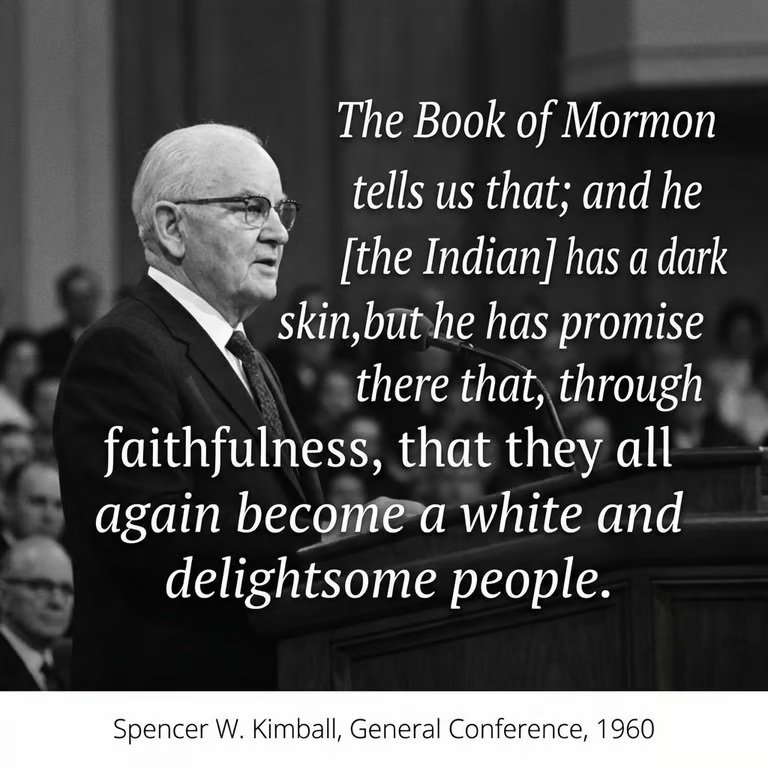
Until 1981, the Book of Mormon explicitly taught that God cursed people with dark skin as a sign of unrighteousness. This was not a fringe interpretation—it was the standard teaching in Mormonism for roughly the first 150 years of its history. It’s certainly what I was taught growing up Mormon. One of the most well-known phrases reflecting this doctrine was that the righteous would become “white and delightsome,” language that appeared plainly and repeatedly in the Book of Mormon.
Today, however, the Mormon Church is actively disavowing that teaching.
In 1981, the Church changed the wording in 2 Nephi 30:6 from “white and delightsome” to “pure and delightsome.” Mormon apologists claim this change merely restores an 1840 revision allegedly made by Joseph Smith himself. According to that narrative, the Church was simply correcting the text to reflect the prophet’s original intent.
But that explanation collapses under scrutiny.
First, if Joseph Smith truly corrected the phrase in 1840, then the Book of Mormon contained incorrect wording for the first 10 years of its existence—during the very period when Smith was alive, actively editing the text and calling it the “most correct book on earth.”
Second, even after that supposed 1840 correction, nearly every printed Book of Mormon continued to read “white and delightsome” until 1981. That means the “wrong” wording remained in circulation for well over a century—long after multiple prophets, apostles, and official committees had full control over the text.
Third, the revised wording directly contradicts numerous other passages in the Book of Mormon that still explicitly link skin color to divine curses and blessings—passages that have never been altered and still appear in current editions.
Most importantly, Mormon prophets didn’t merely allow this interpretation—they taught it openly. Church leaders repeatedly taught that Black people could literally become lighter-skinned if they were righteous enough.
Spencer W. Kimball explicitly said this in General Conference, describing how the skin of faithful Native Americans was becoming “lighter.” Mormons are taught that General Conference messages are authoritative and inspired—effectively scripture. If the Church now claims that skin color was never part of the curse, then it must also admit that its prophets taught false doctrine from the pulpit.
This creates an even deeper problem, because Mormons are also repeatedly assured that while their leaders are fallible, they will never lead the church astray. Both claims cannot be true at the same time.
To illustrate the problem clearly, I own a 1963 edition of the Book of Mormon. In 2 Nephi 30:6, it reads:
“Many generations shall not pass away among them, save they shall be a white and delightsome people.”
That verse is cross-referenced to several other passages—all of which still read the same today:
2 Nephi 5:21 teaches that because the Lamanites rebelled, God caused “a skin of blackness” to come upon them so they would not be “enticing” to the righteous.
Jacob 3:8 warns the Nephites that unless they repent, the Lamanites’ skins will be whiter than yours at the judgment.
Alma 23:18 teaches that when certain Lamanites became righteous, “the curse of God did no more follow them.”
3 Nephi 2:14–16 explicitly states that when Lamanites joined the Nephites, “their curse was taken from them, and their skin became white like unto the Nephites,” and that they became “exceeding fair.”
These verses have not been reworded. They still explicitly tie righteousness and divine favor to lighter skin, and wickedness to darker skin.
So when modern Mormon leaders claim that the “curse” in the Book of Mormon was not about skin color, that claim is not a misunderstanding—it is a direct contradiction of their own scriptures and their own prophetic teachings. At that point, the issue is no longer interpretation. It is historical revisionism…in other words, lying.